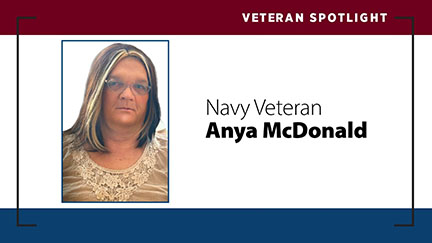
For anyone struggling through homelessness or other hard times, Navy Veteran Anya McDonald has some words of advice: “Be patient even when there seems to be no light at the end of the tunnel, because the light will shine through when you least expect it.”
McDonald has waited for that light many times, through her family’s rejection of her transgender identity, her recovery from a violent sexual assault and her years-long search for a stable place to live.
When McDonald felt like giving up, she found strength in telling herself that tomorrow could be different and the light could be right around the corner.
A dark time
In the mid-1970s, McDonald’s mother took her to a recruiting office hoping the military would “make a man out of her.” With the Vietnam War drawing to a close, McDonald enlisted half-hoping she would die and end the pain of living in the wrong body.
She would serve for a little over a year, sailing to the Caribbean and across the North Atlantic to Europe before being honorably discharged.
One of McDonald’s darkest moments occurred during that 15-month period. Returning to the ship from an evening out, McDonald was abducted off the street by several men in a van and raped. She did not report the assault for fear of victim blaming, instead burying the memories as best she could.
Over the next two decades, McDonald would stay with her mother and stepfather, or father and stepmother, periodically continuing to live as a man. In 1998, she made the decision to leave for California where she hoped to be able to live as her authentic self.
Finding the light
Though she was homeless when she arrived, this marked a turning point in McDonald’s life because she was finally free to begin her transition. The decision cost her relationships with her family, but she said she hasn’t looked back since.
“Don’t let the people who have put you down win. The best revenge you can get on them is being everything you can be and everything they don’t want you to be,” she said.
McDonald traveled around the country over the next decade, never staying in one place for long. Facing rejection from her family, she was also dealing with memories of her assault that had resurfaced during the therapy sessions that were required before her transition.
While at a Salvation Army shelter in Minnesota’s twin cities, McDonald was connected with VA homeless services and got her first apartment through the Housing and Urban Development-VA Supportive Housing (HUD-VASH) program in 2016.
She’s been in HUD-VASH housing ever since and is thankful for VA’s support in overcoming homelessness.
Today, McDonald has big dreams for her future. She enjoys writing and hopes to publish a book. As a recently ordained minister she also would like to open her own church.
Learn about VA programs
If you are a Veteran who is homeless or at risk for homelessness, call the National Call Center for Homeless Veterans at 877-4AID-VET (877-424-3838).
Visit the VA Homeless Programs website to learn about housing initiatives and other programs for Veterans exiting homelessness.
Check out the Ending Veteran Homelessness podcast to learn more about what VA is doing about Veteran homelessness.
Learn how to get involved with housing homeless Veterans.
Subscribe to the Homeless Programs Office newsletter to receive monthly updates about programs and supportive services for Veterans experiencing or at risk of homelessness.